The Hidden Cost of AI: Why CXOs Must Monitor Both Cloud Infrastructure and AI Token Spend
- Sumukha Rao
- Jul 14
- 4 min read


The New Cost Center Most Organizations Are Underestimating
Over the last decade, cloud computing transformed IT from a capital expenditure model into an operational expenditure model. Organizations gained agility, scalability, and faster innovation. However, this transformation also introduced a new challenge: uncontrolled and often invisible cost growth.
Today, a second wave is underway. Artificial Intelligence is becoming deeply embedded into business applications, customer experiences, employee productivity tools, and decision-making systems. While AI promises unprecedented business value, it introduces an entirely new consumption model — token-based pricing.
For CXOs, this creates a critical challenge:
How do you control cloud infrastructure costs and AI consumption costs while ensuring optimal performance and business outcomes?
The answer lies in intelligent observability and proactive cost governance.
Cloud Costs Are No Longer Just an IT Problem
In many enterprises, cloud spending has become one of the fastest-growing operational expenses.
A common pattern emerges:
Applications are over-provisioned to avoid performance risks.
Development and test environments remain active longer than necessary.
Unused resources continue consuming budgets.
Teams lack visibility into the business value generated by cloud investments.
As organizations expand across multi-cloud and hybrid environments, cost accountability becomes increasingly difficult.
Without proper observability, organizations often discover cost overruns only after receiving the monthly invoice.
At the executive level, this creates challenges around:
Budget forecasting
Profitability management
Digital transformation ROI
Technology investment decisions
Regulatory and governance requirements
What is required is not simply infrastructure monitoring, but continuous visibility into cost, utilization, performance, and business impact.
The Emerging Challenge: AI Token Costs
While cloud costs are relatively familiar, AI introduces a much less understood expense category.
Every interaction with a Large Language Model (LLM) consumes tokens.
Organizations deploying AI across:
Customer support
Digital banking
Insurance claims processing
Fraud detection
Knowledge management
Employee assistants
Software development
may process millions—or even billions—of tokens every month.
The challenge is that token consumption often scales much faster than expected.
A few examples:
Poorly optimized prompts generating excessive output.
Multiple AI agents making redundant calls.
Excessive context windows increasing processing costs.
Uncontrolled experimentation by development teams.
AI services running continuously without governance controls.
Many organizations are surprised to find that AI token expenditure begins growing at a pace similar to cloud infrastructure spend.
For CFOs and CIOs, unmanaged token consumption can significantly impact operational budgets.
Why Traditional Monitoring Tools Are No Longer Enough
Traditional monitoring platforms focus primarily on:
CPU utilization
Memory consumption
Network throughput
Storage metrics
Application performance
While important, these metrics do not answer key executive questions:
Which business services are driving cloud costs?
Which applications generate the highest AI token consumption?
What is the cost per transaction?
What is the cost per customer interaction?
Which AI workloads deliver measurable business value?
Where can costs be optimized without affecting customer experience?
Modern enterprises require a unified view of:
Performance + Availability + Cost + AI Consumption
Only then can organizations make informed business decisions.
The Business Impact of Observability-Driven Cost Management
Organizations that continuously monitor infrastructure and AI consumption gain significant advantages:
Improved Financial Predictability
Real-time visibility into cloud and AI spend enables more accurate budgeting and forecasting.
Faster Cost Optimization
Unused resources, oversized workloads, and inefficient AI interactions can be identified before costs escalate.
Better Business Alignment
Technology spending can be directly linked to business outcomes and revenue-generating services.
Reduced Operational Risk
Performance degradation, service disruptions, and unexpected cost spikes can be proactively addressed.
Increased AI ROI
Organizations can measure whether AI investments are delivering value relative to consumption costs.
How AssurePulse AI Helps Organizations Stay Ahead
At Ta3s, we built AssurePulse AI to address a growing reality:
Organizations need more than monitoring—they need intelligent observability combined with proactive cost governance.
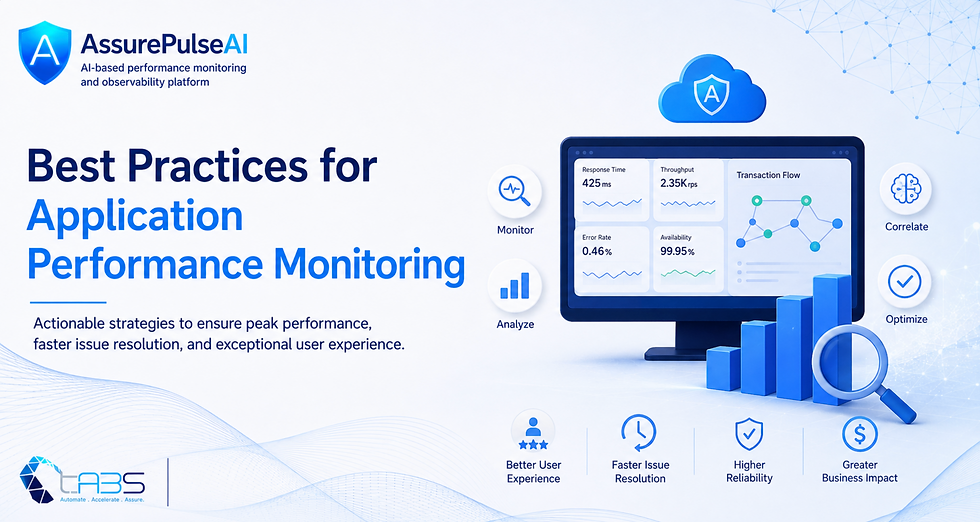
AssurePulse AI provides a unified platform that helps organizations monitor, observe, analyze, and optimize both infrastructure and AI workloads.
Comprehensive Infrastructure Observability
AssurePulse AI provides visibility across:
Cloud infrastructure
Hybrid environments
Applications
Databases
Containers and Kubernetes
Network services
Business transactions
This enables teams to quickly identify performance bottlenecks, reliability issues, and resource inefficiencies.
Cloud Cost Visibility
The platform helps organizations:
Track resource utilization continuously
Identify underutilized infrastructure
Detect anomalous spending patterns
Correlate performance with infrastructure costs
Improve capacity planning decisions
Instead of reacting to monthly invoices, organizations gain proactive cost intelligence.
AI Token Consumption Monitoring
One of the emerging differentiators of AssurePulse AI is its ability to provide visibility into AI usage and token consumption.
Organizations can:
Monitor token utilization trends
Track AI model consumption
Identify expensive prompts and workflows
Analyze AI usage by application, team, or business unit
Detect abnormal consumption patterns
Optimize AI operations for maximum ROI
This allows leadership teams to establish governance frameworks before AI costs become unmanageable.
AI-Powered Insights and Recommendations
Rather than overwhelming teams with dashboards and alerts, AssurePulse AI uses intelligence to:
Detect anomalies automatically
Identify root causes faster
Recommend optimization actions
Predict future resource requirements
Forecast potential cost escalations
This transforms observability from a reactive function into a strategic business capability.
The CXO Perspective: Observability Is Now a Boardroom Discussion
Technology investments are no longer evaluated solely on uptime and availability.
Boards and executive leadership teams increasingly ask:
What is our cloud ROI?
Are we optimizing technology investments?
How much are we spending on AI?
What business value are we receiving from that spend?
How do we scale AI responsibly and sustainably?
The organizations that succeed in the AI era will not necessarily be those that spend the most.
They will be the organizations that achieve the greatest business outcomes from every cloud resource and every AI token consumed.
Finally
Cloud infrastructure and AI are now foundational to modern business operations. However, without visibility and governance, both can quickly become significant sources of uncontrolled expenditure.
Monitoring performance alone is no longer enough.
Organizations must continuously observe:
Infrastructure health
Application performance
User experience
Cloud spending
AI token consumption
Business outcomes
With intelligent observability and cost-aware insights, enterprises can maximize innovation while maintaining financial discipline.
AssurePulse AI empowers organizations to achieve exactly that—delivering deep observability, proactive monitoring, AI-powered intelligence, and cost optimization across both cloud infrastructure and AI ecosystems.
Because in today's digital economy, the most successful organizations will be those that can optimize not just their systems—but every dollar and every token they consume.
Learn more: AssurePulse AI 📧 contact@ta3s.com 🌐 https://assurepulse.ai


Comments