AI Will Empower, Not Destroy the Marketplace — If We Evolve With It


Artificial Intelligence (AI) is often portrayed as a looming threat — a force that will replace jobs, destabilize economies, and widen inequality. While these concerns are not unfounded, they represent only one side of a much larger transformation. History shows us that every major technological shift — from the Industrial Revolution to the Internet — has disrupted existing systems but ultimately created far greater opportunities.
AI is no different. It is not here to destroy the marketplace; it is here to redefine it. The real question is not whether AI will replace humans, but how humans can evolve alongside AI.
AI Is a Tool — Not a Replacement for Human Intelligence
At its core, AI is not an independent decision-maker as of now. It is a tool — powerful, yes — but still dependent on:
Data quality
Context
Human judgment
Ethical frameworks
AI systems excel at pattern recognition, automation, and speed. However, they lack:
Intuition
Emotional intelligence
Moral reasoning
Contextual understanding beyond training data
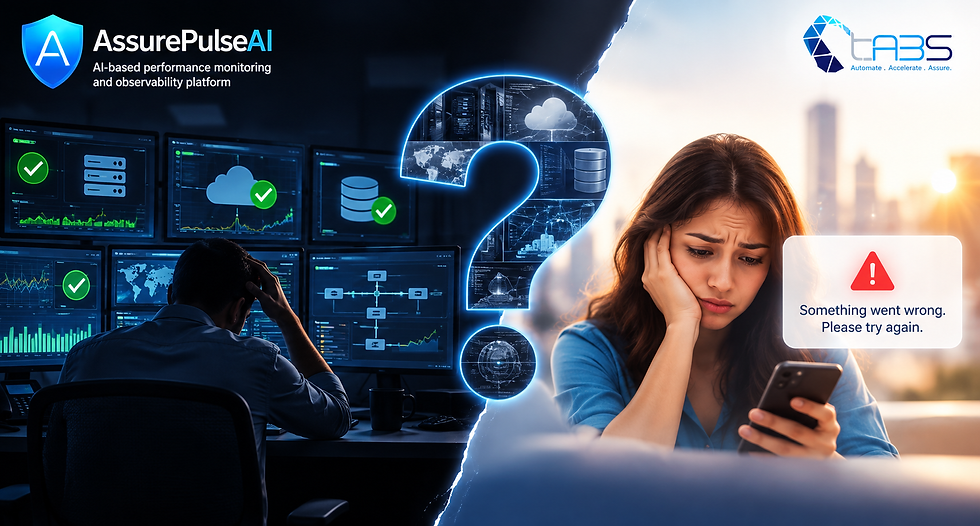
For example, in industries like Application Performance Monitoring (APM) — where your company Ta3s operates using their state of the art tool called AssurePulseAI — AI can identify anomalies, predict failures, and automate alerts. But:
It cannot fully understand business impact without human context
It cannot decide strategic priorities
It cannot replace customer trust and accountability
This is where human expertise becomes irreplaceable. AI augments decision-making — it does not replace it.
AI Will Reshape Jobs — Not Eliminate Work
It is true that AI will disrupt the workforce. Jobs involving repetitive, rule-based tasks are already being automated. Roles such as:
Data entry
Basic customer support
Routine testing and monitoring
Administrative processing
are at high risk.
However, AI is also creating entirely new categories of work:
AI model trainers and auditors
Data engineers and prompt engineers
AI ethics and governance specialists
Human-AI interaction designers
The challenge is not job loss — it is skill transition.
Those who continuously upskill will thrive. Those who resist change may struggle.
The Hidden Risk: Mental Health and Identity Crisis
One of the most overlooked consequences of AI disruption is its psychological impact.
For individuals performing routine work, AI can create:
Job insecurity
Loss of purpose
Fear of irrelevance
Depression and anxiety
Work is not just about income — it is about identity, dignity, and contribution. When AI replaces familiar roles, people are forced to confront uncertainty.
This is especially true in emerging economies where:
Large portions of the workforce are engaged in repetitive or low-skill jobs
Access to reskilling is limited
If not managed carefully, AI could lead to a mental health crisis alongside an economic shift.
Organizations and governments must therefore invest not only in technology, but also in:
Reskilling programs
Emotional and psychological support
Career transition frameworks
AI Will Be the Most Disruptive Technology of Our Time
Unlike previous technological revolutions, AI is not limited to a single sector. It is horizontal — impacting every industry simultaneously:
Healthcare
Finance
Manufacturing
Education
Entertainment
Cybersecurity
AI is also self-improving, meaning its pace of change will accelerate over time.
This makes AI potentially the most disruptive technology in human history.
But disruption does not mean destruction. It means transformation.
Companies that adopt AI effectively will:
Improve efficiency
Reduce costs
Deliver better customer experiences
Innovate faster
Those that ignore it risk becoming obsolete.
Regulating AI: Necessary but Extremely Difficult
As AI grows in power, the need for regulation becomes critical. Key concerns include:
Data privacy
Algorithmic bias
Misinformation
Autonomous decision-making
Job displacement
However, regulating AI is far more complex than regulating traditional industries.
Why Regulation Is Difficult
Technology Moves Faster Than Policy Governments operate in years; AI evolves in months.
Global Nature of AI AI systems are not bound by geography. A model trained in one country can be deployed globally.
Lack of Standardization There is no universal framework for AI governance.
Innovation vs Control Dilemma Over-regulation can stifle innovation, while under-regulation can lead to misuse.
The US–China AI Race: A Strategic Challenge
The challenge of regulation becomes even more complex due to geopolitical competition, particularly between the United States and China.
The United States prioritizes innovation, private enterprise, and market leadership.
China emphasizes state control, large-scale data utilization, and rapid deployment.
Both nations view AI as a strategic asset — critical for:
Economic dominance
Military capabilities
Global influence
This creates a situation where:
Strict regulation could slow down progress
Lack of regulation could create ethical and security risks
As a result, global consensus on AI governance is difficult to achieve.
The Way Forward: Human + AI Collaboration
The future is not AI vs Humans — it is AI with Humans.
To ensure AI empowers rather than disrupts negatively, we must focus on:
1. Continuous Upskilling
Learning must become lifelong. Adaptability will be the most valuable skill.
2. Ethical AI Development
Organizations must embed fairness, transparency, and accountability into AI systems.
3. Human-in-the-Loop Systems
Critical decisions should always involve human oversight.
4. Focus on Higher-Order Skills
Creativity, empathy, strategic thinking, and leadership will define future roles.
5. Responsible Business Adoption
Companies must balance efficiency with social responsibility.
In Short
AI is not the end of human work — it is the beginning of a new kind of work.
Yes, it will disrupt industries. Yes, it will replace certain jobs. Yes, it may create anxiety and uncertainty.
But it will also:
Create new opportunities
Enhance human capabilities
Drive unprecedented innovation
The marketplace will not be destroyed. It will evolve.
Those who see AI as a threat will resist it. Those who see it as a tool will leverage it.
And those who learn to collaborate with it will lead the future.

Comments