The Last Mile: Why Performance Engineering is the Missing Piece in APM and Observability

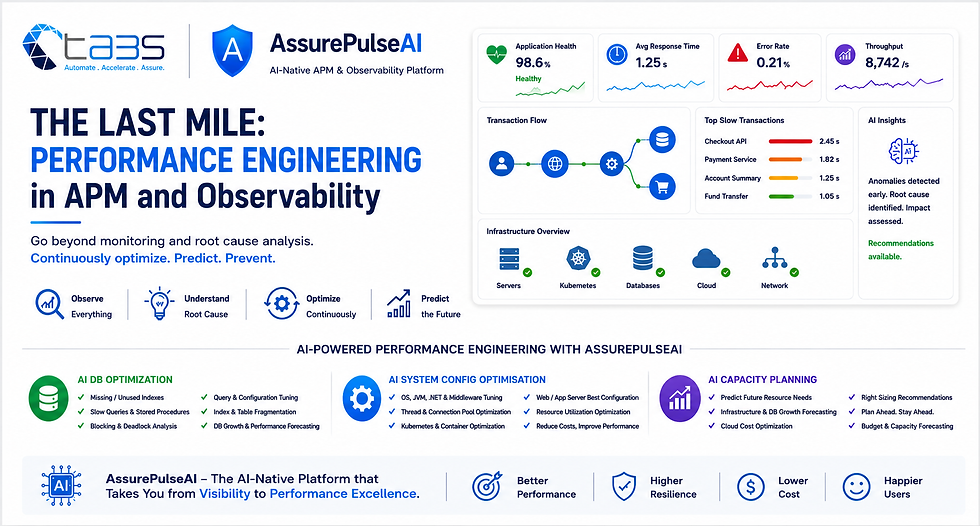
"Monitoring tells you what happened. Observability explains why it happened. Performance Engineering ensures it never happens again."
For years, enterprises have invested heavily in Application Performance Monitoring (APM) and Observabilityplatforms. These solutions have become indispensable for collecting metrics, analysing logs, tracing transactions, monitoring infrastructure, and detecting anomalies across increasingly complex IT environments.
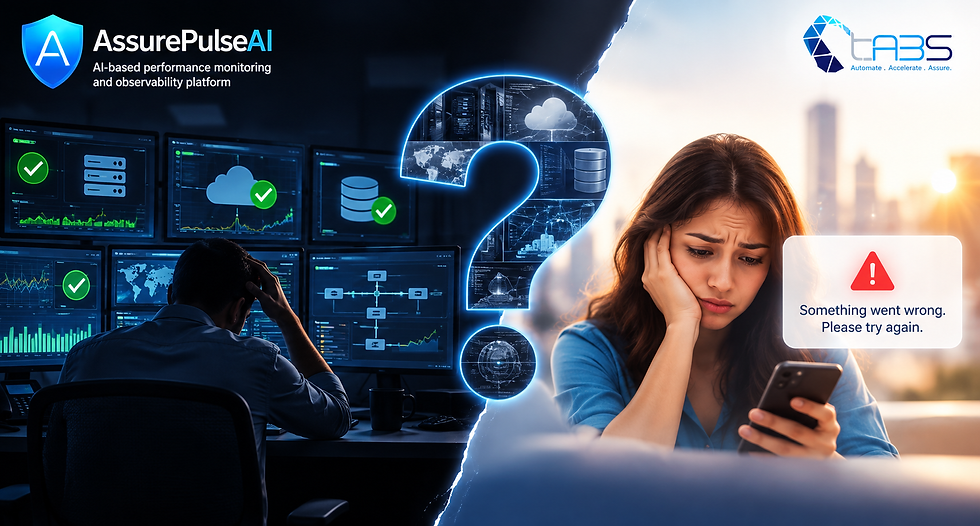
Yet despite all this visibility, organisations continue to experience slow applications, performance bottlenecks, scalability issues, rising cloud costs, and production incidents.
Why?
Because most observability platforms stop at detection.
They tell you what is happening.
Some even explain why it is happening.
Very few tell you how to improve performance and prevent it from happening again.
That missing capability is the last mile of observability—Performance Engineering.
The Evolution of APM and Observability
Application Performance Monitoring has evolved dramatically over the past decade.
It started with monitoring servers:
CPU
Memory
Disk
Network
Process availability
Then came modern observability with:
Distributed tracing
Log analytics
Metrics correlation
Synthetic monitoring
Business transaction monitoring
Kubernetes monitoring
AI-powered anomaly detection
Today's leading platforms can quickly tell you:
Which API is slow
Which transaction failed
Which database query is consuming excessive CPU
Which Kubernetes pod restarted
Which microservice is causing latency
Which cloud resource is overloaded
This visibility is incredibly valuable.
But once the issue has been identified, engineering teams are still left asking:
"What should we optimise?"
Most observability platforms leave that answer to engineers.
Visibility Without Optimisation
Imagine visiting a doctor.
After a comprehensive health check, the doctor tells you:
Your blood pressure is high.
Your cholesterol is elevated.
Your sugar levels are increasing.
Then the consultation ends.
No treatment.
No prescription.
No action plan.
That wouldn't solve the problem.
Yet this is exactly how many APM and observability platforms operate today.
They excel at diagnostics but stop short of recommending meaningful improvements.
Performance Engineering: The Missing Layer
Performance Engineering extends observability beyond detection and root cause analysis.
Instead of simply asking:
"Where is the problem?"
Performance Engineering asks:
Why is this SQL query slow?
Which indexes should be created or removed?
Why is this API consuming excessive memory?
Which application configuration is limiting throughput?
Why does performance degrade during peak traffic?
Is Kubernetes over-provisioned?
Can cloud costs be reduced without affecting performance?
Will this infrastructure support future business growth?
This is where organisations begin moving from reactive firefighting to continuous optimisation.
Why Most Vendors Stop Here
Building a world-class observability platform is already an enormous engineering challenge.
Building an intelligent Performance Engineering platform is even harder.
It requires deep expertise across:
Software architecture
Databases
Operating systems
Cloud platforms
Kubernetes
Networking
Performance testing
Capacity planning
Artificial Intelligence
Most vendors specialise in collecting telemetry.
Very few specialise in transforming telemetry into intelligent optimisation recommendations.
As a result, organisations still depend on performance engineers, DBAs, cloud architects, infrastructure specialists, and consultants to manually analyse issues and recommend improvements.
This process is slow, expensive, and reactive.
AI is Transforming Performance Engineering
Artificial Intelligence is fundamentally changing how enterprises optimise applications.
Instead of asking engineers to manually investigate thousands of dashboards and millions of telemetry events, AI continuously learns how applications behave.
It identifies:
Performance degradation trends
Infrastructure inefficiencies
Database bottlenecks
Configuration issues
Memory leaks
Capacity constraints
Cloud overspending
API regressions
Hidden performance risks
More importantly...
AI recommends what should be improved before users experience problems.
Observability evolves from:
Monitor → Observe → Understand → Optimise → Predict
This is the future of enterprise operations.
How AssurePulseAI Bridges the Last Mile
At AssurePulseAI, we believe observability should not end with dashboards.
It should lead directly to optimisation.
Our AI-native platform combines:
Application Performance Monitoring
Full Stack Observability
Performance Engineering
AI-powered Recommendations
into a single intelligent platform.
Instead of simply reporting issues, AssurePulseAI continuously analyses application behaviour and provides actionable recommendations across applications, databases, infrastructure, cloud environments, Kubernetes, and business transactions.
AI Database Optimisation
Databases remain one of the largest contributors to application latency.
Traditional monitoring tools identify slow queries and blocking sessions but leave database administrators to manually investigate execution plans, indexes, and configuration settings.
AssurePulseAI introduces AI-powered Database Optimisation, continuously analysing workload patterns, execution plans, telemetry, and historical behaviour to identify opportunities for improvement.
AI automatically recommends:
Missing indexes
Duplicate indexes
Unused indexes
Long-running SQL queries
High CPU-consuming queries
Query execution plan optimisation
Stored procedure optimisation
Blocking session analysis
Deadlock analysis
Table fragmentation
Index fragmentation
Connection pool tuning
Memory optimisation
Database parameter tuning
Replication performance improvements
Database growth forecasting
Rather than simply highlighting problems, AssurePulseAI explains:
Why performance is degrading
What should be changed
Expected performance improvement
Business impact
Optimisation priority
Database optimisation becomes proactive instead of reactive.
AI System Configuration Optimisation
Performance issues aren't always caused by application code.
Operating system parameters, JVM settings, application servers, container limits, Kubernetes resources, web servers, storage configuration, and network settings all influence application performance.
AssurePulseAI continuously analyses the complete technology stack and identifies configuration improvements tailored to each customer's workload.
The platform evaluates:
Operating system configuration
Linux kernel parameters
Windows Server configuration
JVM tuning
.NET runtime settings
Application server optimisation
Web server configuration
Thread pool sizing
Connection pool configuration
Redis tuning
Kubernetes resource requests and limits
Container sizing
Network optimisation
Storage configuration
Load balancer tuning
Cloud instance selection
Instead of relying on generic vendor best practices, recommendations are based on actual production workloads, making them more accurate and impactful.
The result is improved application performance, higher stability, and lower infrastructure costs.
AI Capacity Planning
Capacity planning has traditionally relied on spreadsheets, historical averages, and educated guesses.
Modern digital businesses require far more intelligence.
AssurePulseAI introduces AI-driven Capacity Planning, enabling organisations to anticipate demand before performance is affected.
The platform continuously analyses:
Historical resource utilisation
Business transaction growth
CPU trends
Memory consumption
Database growth
Storage utilisation
Kubernetes cluster usage
Cloud resource consumption
Network bandwidth
Seasonal demand
Infrastructure efficiency
Using AI, AssurePulseAI predicts:
Future infrastructure requirements
Database storage growth
Kubernetes cluster expansion
Compute requirements
Memory requirements
Cloud cost optimisation opportunities
Infrastructure consolidation opportunities
Budget forecasting
Hardware refresh planning
Capacity planning becomes continuous, predictive, and data-driven rather than an annual exercise.
AI That Doesn't Just Detect Problems—It Solves Them
Most observability platforms excel at identifying issues.
AssurePulseAI goes significantly further.
Its AI engine continuously learns from:
Application performance
Infrastructure utilisation
Database workloads
Configuration changes
Business transactions
Historical incidents
Seasonal trends
Instead of forcing engineers to manually analyse hundreds of dashboards,
AssurePulseAI automatically answers questions such as:
Which optimisation will improve response times the most?
Which database changes will deliver the highest ROI?
Which configuration changes reduce infrastructure costs?
When will additional capacity be required?
Which systems are most likely to experience future bottlenecks?
What is the expected business impact if nothing changes?
Observability becomes an intelligent decision-support system rather than simply another monitoring tool.
From Reactive Operations to Autonomous Optimisation
Traditional APM platforms answer:
What happened?
Where did it happen?
Why did it happen?
AssurePulseAI goes much further.
It answers:
What should be optimised?
Which recommendation should be implemented first?
What is the expected improvement?
Which change reduces operational costs?
How can future incidents be prevented?
What capacity will be required six months from now?
This transforms observability into a continuous optimisation platform.
The Business Value
Performance Engineering is no longer just an engineering discipline.
It directly impacts business outcomes.
By combining observability with AI-driven optimisation, organisations achieve:
Faster application response times
Higher system availability
Lower Mean Time to Detect (MTTD)
Lower Mean Time to Resolve (MTTR)
Improved customer experience
Reduced cloud expenditure
Better infrastructure utilisation
Faster incident resolution
Improved engineering productivity
Better SLA compliance
Predictable capacity planning
Lower operational costs
Every millisecond saved improves customer satisfaction.
Every optimised query reduces infrastructure consumption.
Every AI recommendation prevents future incidents.
This is where observability begins delivering measurable business value.
The Future of APM
The next generation of APM platforms will not compete solely on dashboards, metrics, logs, or traces.
They will compete on intelligence.
Tomorrow's platforms won't simply tell organisations what happened.
They will recommend what to optimise.
Predict what will happen.
Continuously improve application performance.
Eventually, many of these optimisations will be automated.
The future looks like this:
Observe → Understand → Recommend → Optimise → Predict → Automate
That is the future of AI-native Performance Engineering.
The observability industry has made tremendous progress in helping organisations understand their systems.
But understanding alone is no longer enough.
The last mile is helping organisations continuously improve those systems.
That is where Performance Engineering becomes the defining capability of next-generation APM platforms.
At AssurePulseAI, we are closing this gap by combining AI-native Observability, AI Database Optimisation, AI System Configuration Optimisation, and AI Capacity Planning into a single intelligent platform.
Our mission is simple:
Don't just tell customers what's wrong. Help them make it better.
By transforming telemetry into actionable optimisation, AssurePulseAI empowers enterprises to build applications that are faster, more resilient, more cost-efficient, and continuously improving.
Because the future of observability isn't just about seeing everything.
It's about continuously making everything better.
About AssurePulseAI
AssurePulseAI is an AI-native Application Performance Monitoring (APM), Observability, and Performance Engineering platform developed by Ta3s. It provides end-to-end visibility across applications, infrastructure, databases, cloud environments, Kubernetes, networks, and business transactions while leveraging AI to deliver intelligent recommendations for database optimisation, system configuration tuning, capacity planning, and predictive performance improvement. By bridging the gap between observability and optimisation, AssurePulseAI helps enterprises reduce downtime, lower infrastructure costs, accelerate incident resolution, and deliver exceptional digital experiences.

Comments