The True Cost of Downtime: What Your Monitoring Tools Aren’t Telling You


Downtime is often measured in minutes. But its real impact is measured in millions.
While most organizations track outages through dashboards and alerts, what often goes unnoticed is the true cost behind those incidents—costs that extend far beyond system recovery.
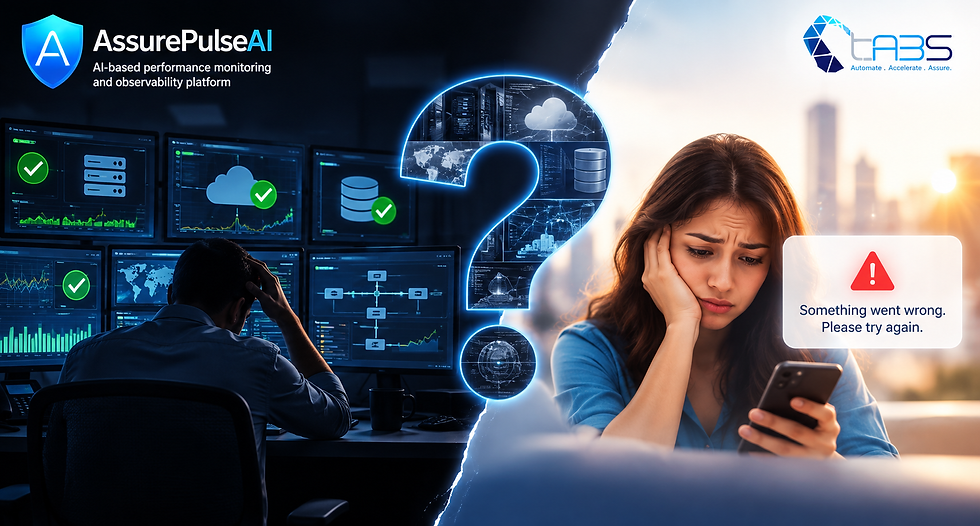
The uncomfortable truth? Traditional monitoring tools only show you what broke, not what it actually cost you.
And more importantly—they don’t help you prevent it.
1. Direct vs. Indirect Losses: The Visible and the Invisible
Most enterprises calculate downtime cost using simple formulas:
Revenue lost per minute
Number of failed transactions
Operational disruption
But these are just the tip of the iceberg.
Direct losses include:
Immediate revenue impact
Transaction failures
Productivity loss
Indirect losses are far more damaging:
Customer abandonment
Reduced lifetime value
Increased acquisition cost
👉 The real danger lies in what you don’t see—the customers who never return.
2. Brand Impact: Trust Takes Years to Build, Seconds to Break
In today’s digital-first world, performance is the brand.
A slow application or outage doesn’t just frustrate users—it reshapes perception.
Users equate performance with reliability
Negative experiences spread instantly
Switching to competitors is frictionless
A single outage can silently erode years of brand equity.
3. SLA Penalties: The Financial Fallout You Can’t Ignore
For enterprises operating under strict SLAs—especially in banking, insurance, and fintech—the cost of downtime extends beyond lost transactions.
It includes:
Contractual penalties
Compliance exposure
Regulatory risks
And more critically, loss of trust with customers and partners.
4. Why Traditional Monitoring Fails to See It Coming
Most legacy APM and monitoring tools are:
Reactive – alerting after incidents occur
Siloed – infrastructure, application, and network disconnected
Complex – requiring heavy setup, tuning, and expertise
They tell you:
✔ What failed
✔ Where it failed
But not:
❌ Why it failed
❌ What will fail next
❌ What it means for your business
By the time alerts trigger, downtime has already impacted revenue and users.
5. From Monitoring to Autonomous Performance Engineering
This is where a fundamental shift is happening.
Forward-looking enterprises are moving beyond traditional observability into.
Autonomous Performance Engineering—where systems don’t just monitor, but think, predict, and act.
Platforms like AssurePulseAI are leading this transformation by:
Predicting failures before they occur using AI-driven pattern recognition
Correlating technical signals with business impact in real time
Eliminating tool sprawl by unifying APM, observability, and performance engineering
Reducing noise and manual intervention through intelligent automation
Instead of reacting to outages, organizations can now prevent them proactively.
6. The Business Impact of AI-Native Monitoring
Adopting an AI-native platform like AssurePulseAI enables:
Reduced downtime incidents through early detection
Lower operational cost by eliminating multiple tools
Improved customer experience and retention
Stronger SLA adherence and compliance posture
Most importantly, it shifts IT from a cost center to a business enabler.
Downtime is a Business Risk, Not Just an IT Issue
Downtime should not be measured in system metrics alone—it must be measured in:
Revenue impact
Customer trust
Competitive positioning
The enterprises that will lead the next decade are not the ones that monitor better— they are the ones that prevent failures intelligently.
Call to Action
It’s time to ask:
👉 Are your monitoring tools helping you react faster… or prevent failures altogether?
The future belongs to organisations that embrace AI-driven, autonomous performance engineering.

Comments